PROPOSAL / V1 AUGUST 2026

dlivrd-GCS · Language training

English
at scale

A language-learning platform owned by dlivrd-GCS. Trains the team in English today, Spanish for the US team next, and becomes the base for every course the company runs after that.

PREPARED BYJorge Rodriguez FORChristine Heffernan DECISIONApprove the first version

The problem

GCS sells bilingual talent. The bilingual part has a ceiling.

The promise on the site is "top bilingual professionals who deliver from day one". That adjective is what makes a professional placeable in a client-facing role — and today the company's ability to produce it depends entirely on one instructor's calendar.

~15
Maximum students that fit in one instructor's week
0
Numbers the company can show a client about the team's English level
31 days
The current training site sat compromised through a WordPress exploit in July

The opportunity

The bottleneck isn't talent.
It's the language.

Colombia has a deep pool of capable, qualified professionals — that is the whole premise of the GCS model. What most of them don't yet have is the language level a client-facing role demands.

  • 01Today "bilingual" is a hiring filter, not a capability the company builds. Strong candidates are turned away for something that can be taught, while hiring competes for the small, expensive slice of the market that already arrives bilingual.
  • 02Anyone can recruit bilingual people. Very few can produce them. Competing for the same pool is competing on price. Training reliably means creating supply nobody else has.
  • 03The talent is already inside the company too. People doing back-office work today who are one language level away from client-facing roles — and from the billing that comes with them.

Training language systematically turns a hiring constraint into a hiring advantage — and widens the supply of the exact thing GCS sells.

Why the current setup can't fix it

The current setup can't produce that at scale

  • 01It cannot assess speaking or writing. No plugin of that generation can. Every recording and every paragraph has to be judged by a person, one at a time.
  • 02Content goes in by hand, screen by screen. Material that already exists in Drive cannot be loaded in bulk.
  • 03Progress isn't visible to anyone but the instructor. No cohort view, no completion reporting, no way to answer "who's on track".
  • 04It's a blog with a course plugin bolted on. WordPress wasn't built for training. LearnDash adds courses; every capability past that — learning paths, gamification, reporting, memberships, certificates — is another plugin, another annual licence, another vendor that can stop maintaining it. And even buying all of them, speech and writing assessment still doesn't exist in that ecosystem.

The platform

A learning platform built for languages, owned by the company

Courses run on a main path with side lessons for the work situations the team actually deals with. Nothing unlocks because time passed — it unlocks when a learner passes.

Deployed once per audience. English for the Colombia team now, Spanish for the US team later, company onboarding after that — same software, separate installs, separate branding.
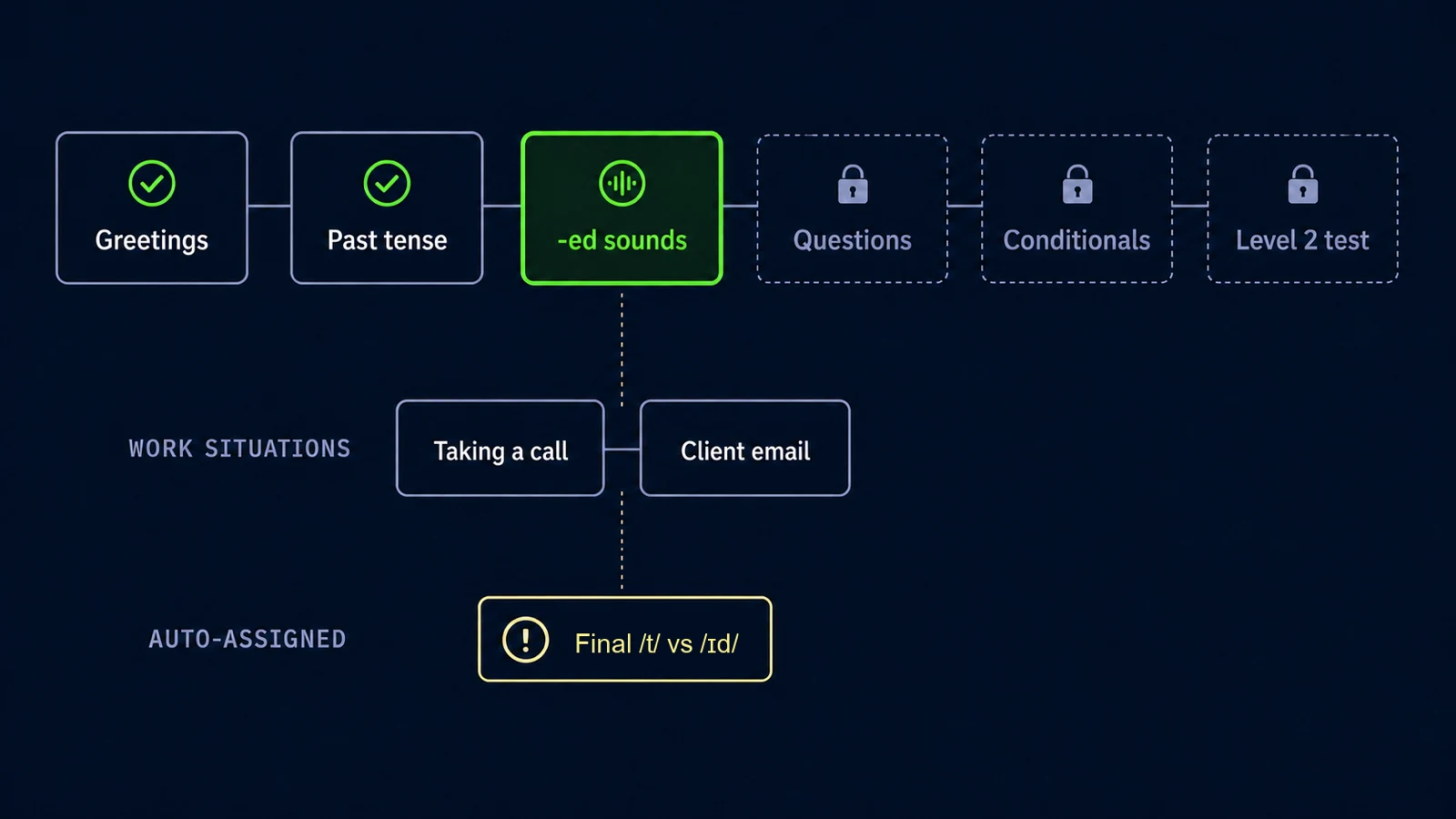
Course path — main line, side lessons, auto-assigned reinforcement

Feature · Content authoring

How content gets into the platform

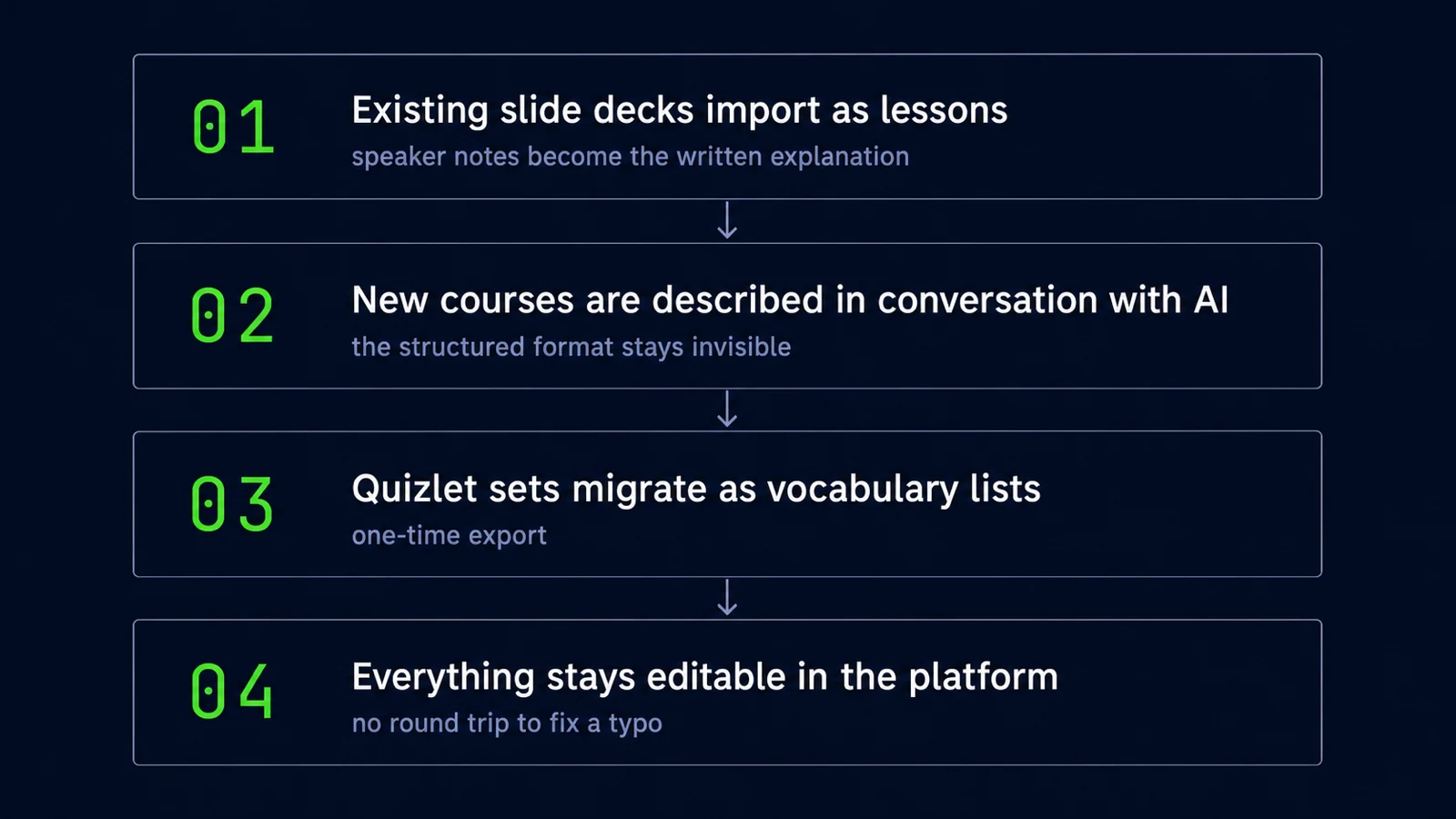
Content gets in without an engineer

This is the part LearnDash gets wrong and the reason the current library never made it onto the platform.

Existing material is reused, not rebuilt. Authoring stays with the instructor, not with the development team — which is what makes the platform grow without adding cost.

Feature · Automatic assessment

The platform grades speech and writing on its own

Speaking is scored sound by sound against a reference, then explained in plain language. Written answers get instant feedback. Every word carries a native recording and its phonetic transcription, pulled automatically.

This is the capability nothing on the market gives the company today, and the one that removes the human bottleneck from practice.
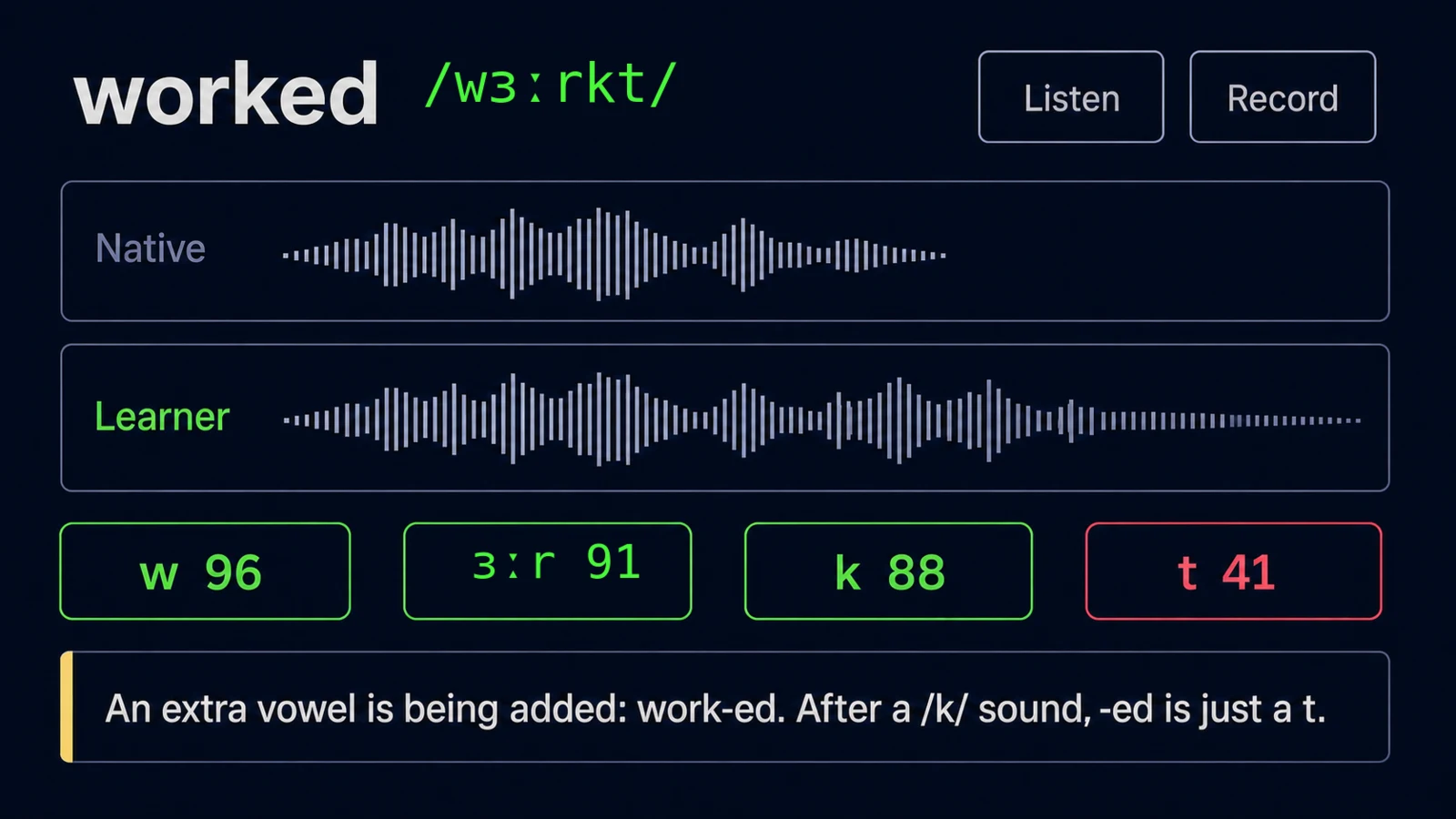
Speech scored sound by sound, with the fix explained

Feature · Teaching operations

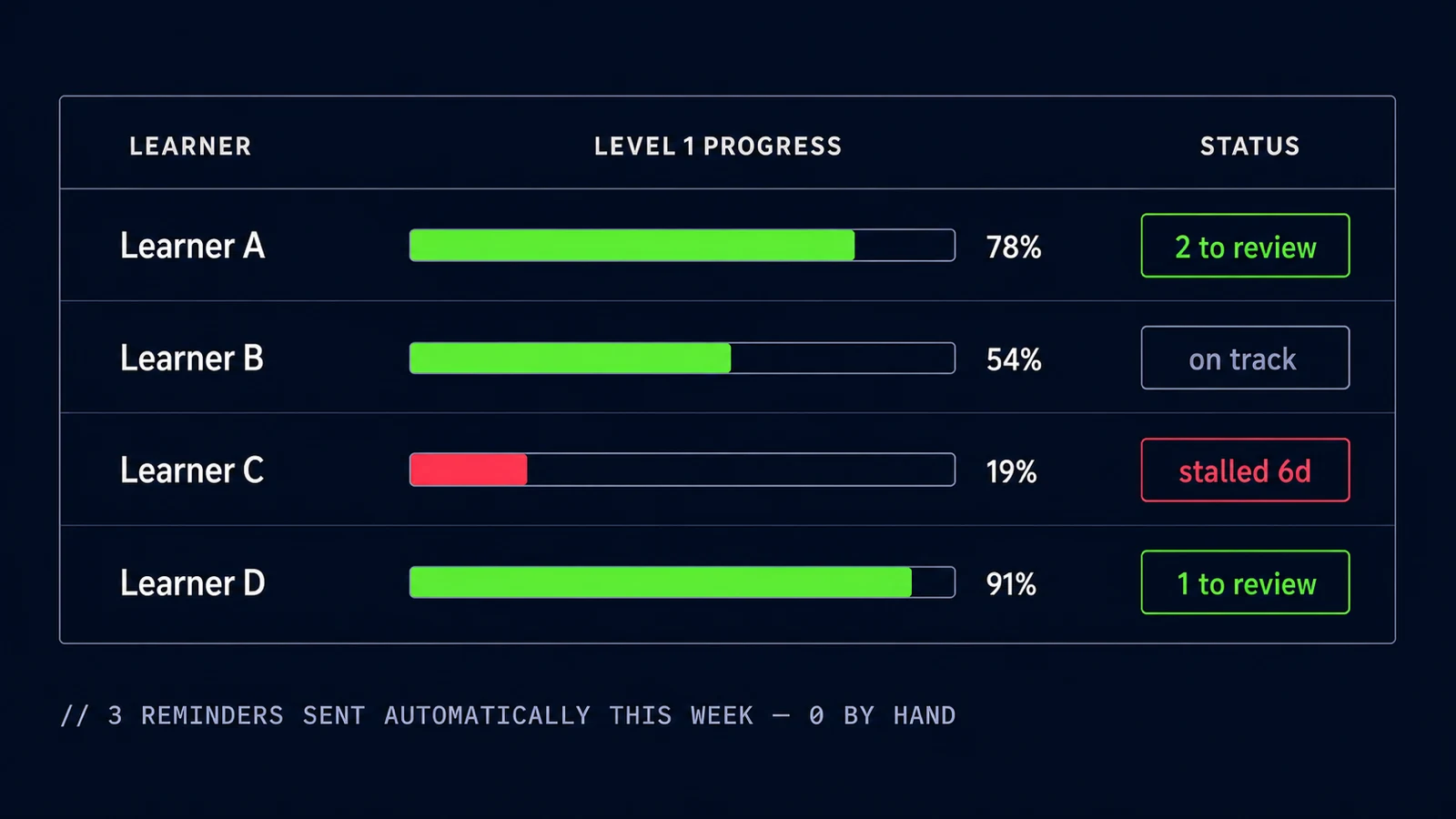
Cohort progress and review queue

One screen replaces chasing people over Slack

Who's moving, who's stalled, what's waiting for review. Reminders go out on their own. Courses get assigned to a whole team instead of one person at a time.

Live sessions stay exactly as they are — but the instructor walks in already knowing what to work on, instead of spending the hour diagnosing.

Feature set · Version 1

What the first version ships with

Access & placement

  • Passwordless login and learner profiles
  • Placement test that assigns a level

Learning

  • Course path with side and auto-assigned lessons
  • Lessons imported from existing slide decks
  • Exercises: multiple choice, gap fill, word order, matching
  • Vocabulary lists with native audio and spaced review

Assessment

  • Record-and-compare speaking practice
  • Sound-by-sound scoring on graded exercises
  • Written assignments with automatic feedback

Teaching & engagement

  • Instructor cohort view and review queue
  • Automatic reminders
  • Streaks and visible progress
  • Session booking, locked until the level is passed

Feature set · Deliberately later

Real scope, deferred on purpose

None of this changes what gets built now. Each one waits on a decision or on the first version proving itself.

  • Points and a redeemable rewards catalogueWaits on the reward rules and someone owning the catalogue
  • Certificates and verifiable credentialsOnly meaningful once levels are formally assessed
  • Automatic availability from Google CalendarVersion 1 books against slots the instructor sets by hand; reading real calendar availability comes later
  • Multiple tutors, each with their own calendarThe programme is designed once and taught by a team — the instructor moves from delivering every class to setting the standard
  • Team-wide assignment and compliance reportingBelongs to the company onboarding deployment
  • Discussion and communityThe team already lives in Slack
  • Spanish for the US teamSame software, second deployment

What it solves for dlivrd-GCS

Training stops being a cost and becomes capacity

A wider hiring pool Today GCS must find candidates who already arrive bilingual. With a system that reliably takes people from intermediate to advanced, it can hire for talent and build the language. Growth, not savings
More placeable agents, better accounts The gap between back-office work and being on a client call is directly billable, and language level is what moves someone across that line. Revenue per agent
A number to show clients "Top bilingual professionals" is a claim the company makes but cannot currently evidence. Assessment turns it into a measurable figure per person and per cohort. Commercial proof
Training that reaches everyone Today English is limited to whoever fits in one calendar. The platform removes the ceiling, so it becomes available to the whole team rather than a few. Retention and culture
One less attack surface Getting off WordPress removes the exploit path that took a training site down for a month, and the 148 outdated plugins behind it. Risk removed
A company asset, not a licence The platform belongs to dlivrd-GCS. It becomes the base for Spanish training, onboarding, and any future course the company runs. Reusable

What it solves for the teaching side

The instructor's reach stops being capped by the calendar

  • 01Practice grades itself. Drills, recordings and repetition are handled by the platform. Review moves from every submission to the ones that count.
  • 02Nobody has to be chased. Reminders and streaks do the follow-up that is currently done by hand, message by message.
  • 03Existing material gets reused. Slide decks and vocabulary sets already built come across instead of being rebuilt.
  • 04Live sessions get sharper. The hour is spent teaching instead of diagnosing, because the gaps are already measured.

Same method, same sessions, many more people reached.

Cost

Less than a quarter of what the company pays right now

LinePer year
Hosting, database, email$60
File storage$0
Speech assessment$0–30
Automatic written feedback$1–10
LearnDash licence today$400
Running the platform$61–100

The real cost

Infrastructure is not the number that matters. The cost is time: development, and the instructor's hours designing the course path and the placement test. That is the figure worth agreeing on up front.

If it doesn't work

Two learners, one course. Nothing currently running is switched off, and every existing system stays exactly where it is.

To start

Four inputs, and two of them block everything

Blocking

The course path — a first sketch of one level

The main line, plus two or three side lessons hanging off it. Without a map there is nothing to build.

Blocking

The placement test

Ten or fifteen questions is enough to start. Questions are data, not code — they can be replaced later without touching the application.

Two pilot learners, at different levels

Two, not ten. A small group keeps the first version honest and fixable.

The pronunciation standard

Speech scoring measures against a native speaker, so a perfectly intelligible Colombian speaker can score 70. If the goal is being understood on a client call rather than sounding American, the bar is set differently. That decision belongs to the instructor, not to the software.

// USE ← → TO NAVIGATE
01 / 14